

INA 319(b): expedited U.S. citizenship for spouses of Americans working abroad.
If you're a green-card holder married to a U.S. citizen stationed overseas in qualifying employment, Section 319(b) can make you a U.S. citizen on a faster timeline — without the standard continuous-residence and physical-presence requirements.
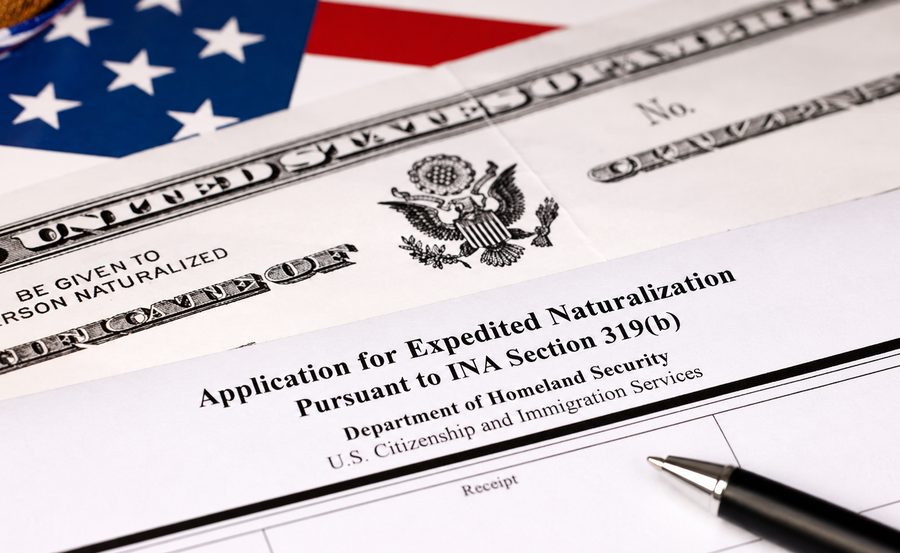
- Who it's for. The lawful permanent resident spouse of a U.S. citizen in qualifying employment abroad.
- The benefit. No standard continuous-residence or physical-presence requirement — citizenship on a faster timeline.
- Qualifying employment. Six statutory categories — U.S. government, research institution, U.S. firm, public international organization, clergy, or missionary work.
- The filing. Form N-400 on the §319(b) basis, supported by the all-important employer evidence.
- Document-sensitive. Early legal screening prevents wasted filing fees and a problematic naturalization record.
What the law actually says
Most people who want U.S. citizenship must first live in the United States as a green-card holder for years. They must also be physically present here for much of that time before they can apply. That is a real problem if your spouse's job has taken you overseas. Section 319(b) of the Immigration and Nationality Act creates a narrow exception for exactly that situation.
In the statute's own words, a qualifying spouse "may be naturalized upon compliance with all the requirements of the naturalization laws, except that no prior residence or specified period of physical presence within the United States … shall be required." In plain terms: if you qualify, you don't have to wait out the usual U.S. residence and physical-presence periods before you naturalize.
Who qualifies — the four things you must show
To naturalize under 319(b), you have to establish each of these:
- You're already a green-card holder. 319(b) speeds up citizenship for a lawful permanent resident. It does not skip the green card. Not an LPR yet? That's a separate step we can help with first.
- You're married to a U.S. citizen. USCIS requires a legally valid marriage in place from the day you file until you take the Oath of Allegiance. Unlike the ordinary three-year spouse rule, 319(b) does not require a set period of "living in marital union."
- Your citizen spouse is employed abroad in a qualifying category and is "regularly stationed abroad" in that job. That means being sent abroad for a period of not less than one year under an employment contract or orders. The six categories are below.
- You'll be in the U.S. to naturalize, and you intend to come back. You must be physically in the United States when you naturalize. You must also declare, in good faith, that you'll take up U.S. residence as soon as your spouse's overseas employment ends. USCIS also asks for a statement of your intent to live abroad with your spouse in the meantime.
Everyone applying still has to meet the ordinary naturalization requirements that 319(b) does not waive — see below.
The six qualifying-employment categories
This is where most 319(b) cases are won or lost. The law recognizes six kinds of overseas employment for the U.S. citizen spouse. What matters is the category, not the employer's name:
- The U.S. government. Federal employment abroad — civilian agencies and the uniformed services alike (for example, the State Department, USAID, or a posting with the U.S. armed forces).
- An American research institution recognized as such by the Attorney General. Recognition is the key question here, so this category usually needs checking.
- An American firm or corporation (or a subsidiary) "engaged in whole or in part in the development of the foreign trade and commerce of the United States." This is the broadest category. Many private-sector assignments with U.S. companies fall here. But the employer's tie to U.S. foreign trade must be shown, not assumed.
- A public international organization in which the United States participates by treaty or statute (for example, the United Nations, the World Bank, or the IMF).
- Clergy of a religious denomination. Someone authorized to perform the ministerial or priestly functions of a religious denomination that has a bona fide organization in the United States.
- A missionary. Someone engaged solely as a missionary by a religious denomination, or by an interdenominational mission organization, that has a bona fide organization in the United States.
"Regularly stationed abroad" has a specific meaning. The citizen spouse must proceed abroad "for a period of not less than one year, pursuant to an employment contract or orders." They must actually assume the duties of the job, not simply travel abroad for work.
You don't have to have already been abroad for a year. USCIS measures the one year from the date you file. It treats the requirement as met if the qualifying employment is scheduled to last at least a year at the time of filing. That holds even if less than a year remains by your interview or oath, as long as your spouse is still employed abroad when you naturalize. The burden is on you to show the assignment was scheduled to run a year.
What 319(b) does — and doesn't — waive
319(b) is powerful but narrow. It removes two big hurdles and leaves the rest of the naturalization rules fully in place.
Waived
- The usual continuous-residence requirement
- The usual physical-presence requirement
Still required
- Lawful permanent-resident status
- Age 18 or older
- Good moral character (the three years before filing)
- The English and U.S. civics tests
- Attachment to the Constitution & the Oath
The statute is explicit that a 319(b) applicant naturalizes "upon compliance with all the requirements of the naturalization laws" except residence and physical presence. So the character, language, civics, and oath requirements all still apply.
How the process works
- File Form N-400, indicating you're applying as the spouse of a U.S. citizen who is (or will be) regularly stationed abroad.
- Prove the employment. This is the heart of the case. You need documentation that the citizen spouse's job fits one of the six categories and that they're regularly stationed abroad: an employer letter describing the business and any U.S. ownership or foreign-trade tie, assignment orders, the nature of your spouse's role, and the anticipated period of the posting abroad.
- Biometrics (fingerprints and photo) in the United States.
- Interview at a USCIS office in the U.S., including the English and civics tests.
- Oath of Allegiance, taken in the United States. You must be in the U.S. to naturalize.
- Return abroad with your spouse, consistent with the intent you declared. USCIS expects you to depart to rejoin your spouse within 30 to 45 days of naturalizing.
How long does it take? The big time saving is up front. 319(b) removes the years of continuous U.S. residence a standard applicant must complete before applying. So a qualifying spouse can file as soon as they hold a green card. The processing time after filing is set by USCIS. It varies by field office, service center, and case type. Check current figures with the official USCIS processing-times tool.
Where cases go wrong
319(b) is document-sensitive. The issues we see most often:
- The employer doesn't clearly fit a category. This is the most common problem, especially in the "U.S. firm engaged in foreign trade" and "recognized research institution" categories.
- "Regularly stationed abroad" is under-documented, including proof that the overseas assignment runs for at least a year, as the regulation requires.
- Thin evidence of intent to live abroad with the spouse now, and to return to the U.S. when the assignment ends.
- Timing. The qualifying employment and the valid marriage generally need to hold up through the oath.
Because a denied N-400 costs the filing fee and can complicate your immigration record, it's worth confirming the category fits before you file.
Sources
This page summarizes federal law and official government guidance in plain language. It is general information, not legal advice.
- Statute — 8 U.S.C. § 1430(b) (INA § 319(b)), Legal Information Institute, Cornell Law School.
- Regulation — 8 CFR § 319.2 (implementing INA § 319(b); defines "regularly stationed abroad").
- USCIS Policy Manual — Volume 12, Part G, Chapter 4: Spouses of U.S. Citizens Employed Abroad.
- USCIS — I Am Married to a U.S. Citizen.
- USCIS — Form N-400, Application for Naturalization, and current USCIS processing times.
Tell us about your 319(b) case.
A licensed U.S. immigration attorney reviews every inquiry — usually within one business day. All inquiries are confidential. Sending this form does not create an attorney-client relationship until we have agreed to represent you in writing.
319(b) questions we hear most.
Can my spouse and I marry abroad and still qualify for 319(b)?
Yes. What matters is that you are a lawful permanent resident married to a U.S. citizen, that the citizen spouse is regularly stationed abroad in qualifying employment, and that you intend to reside abroad with your spouse and return to the United States when the assignment ends.
What counts as "qualifying employment"?
Six statutory categories: the U.S. government (including the military); a U.S. research institution recognized by the Attorney General; a U.S. firm or corporation engaged in the development of foreign trade and commerce of the United States (or a subsidiary); a public international organization of which the United States is a member; clergy authorized to perform the ministerial or priestly functions of a religious denomination with a bona fide U.S. organization; or someone engaged solely as a missionary for such a denomination or an interdenominational mission organization.
How long does the 319(b) process take?
319(b) removes the years of continuous U.S. residence a standard applicant must complete before applying, so you can file as soon as you hold a green card. The processing time after filing is set by USCIS and varies by field office, service center, and case type — see the official USCIS processing-times tool. You'll travel to the United States for the interview and the oath ceremony.
I'm not a green card holder yet. Can you still help?
Yes. 319(b) requires that you already be a lawful permanent resident — but if you are not yet, we can help you obtain the green card first and then pursue 319(b) naturalization.
What if my spouse's assignment ends before my oath?
USCIS looks at whether the assignment was scheduled to last at least a year when you filed. If it was, you can still naturalize even if less than a year is left by the time of your interview or oath. Your spouse must still be employed abroad when you take the oath. The qualifying employment must hold up through naturalization, so we build the timeline into the case strategy from the start.
Naturalize on the right timeline.
Free consultation with a U.S. immigration attorney. We'll tell you honestly whether 319(b) fits your situation.